
Author: Crystal Fleming
Crystal Marie Fleming is a writer, professor and sociologist.
Damn. It’s like that?!

Ouch!
Alan Watts on the Tao Te Ching
The Nondual Academic: A New Series
This blog is the first in a 12 week series of essays on doing academic work from a nondual, spiritual perspective. Most Sundays, I’ll share my reflections on a variety of topics related to writing, researching, teaching and mentoring in the light of teachings from Hinduism, Buddhism and Christian mysticism as well as my own experiences.
* * *
The Spirit of “Getting-Shit-Together” is moving swiftly and deeply in my life after a prolonged absence. While this year has been incredibly transformative and productive in terms of my spiritual growth, creative expression and general happiness, I’ve been waiting patiently for inspiration, organization, clarity and focus to return to my work life. The time has definitively come. As Madea would say, Hallelujerrrr!
I’m not terribly into astrology, but I do like to check Susan Miller’s monthly forecasts from time to time. Sometimes I look retrospectively at the past month (without having seen it first) to see if her predictions were correct. I went ahead and checked what she said about October and couldn’t help but note a few uncanny truths:
“You ended September on a troubling note, as the monstrous moon of September 29 was not likely an easy one. It lit your house of romance, so you may have seen a side of character of someone you are dating that you found troublesome . . .”
Mmm hmm. Something like that. Now onto the important stuff:
“Now Saturn moves into a very gentle place of your chart, your twelfth house, a place of privacy and rest. I feel that Saturn in this house is the very best you can have to work behind closed doors to see impressive productivity. If you do research, are working on a thesis or grant, write, edit, create computer software or apps, or are a scientist that needs quiet time to experiment, this is precisely the place you want Saturn to be to excel. You will have Saturn here for three years, until September 2015.”
Great. Looks like Saturn got moving just in time for me to get my tenure dossier together over the next few years. I’ve been more productive with my research in the past two weeks than I have since I joined the faculty at my university last year. And, for the first time, oh, ever, I am finally working from a place of joy and inspiration rather than the crushing stress, professional paranoia and competitive drive that I absorbed in graduate school at Harvard.
One of my on-going life projects this year has been figuring out how to do my research, teaching and mentoring in a non-egoic, spiritually centered way. I reached out to colleagues who are also spiritually inclined and spent a lot of time simply figuring out the kind of life I want to live – getting my priorities in order. In the winter of 2011, after turning 30, I realized my relationship with God had always been on the back burner. Due to a confluence of events – and grace – my spirituality (a mix of Christianity, Buddhism and Hinduism) became the most important thing in my life.
With my spiritual allegiances clearly staked, I found that I simply did not care about work in the way I used to. While my research on racism was always motivated by my desire to expand the opportunity structure, reduce inequality and promote harmonious intergroup relations, there was also a hell of a lot of ego involved. In the past, my benevolent intentions were also contaminated with an obsessive need for recognition and prestige.
I felt both relieved — and troubled — by my new priorities. While I was very happy to have let go of so much of my competitive narcissism, I was also worried about what this would mean for my career. Tenure-track professors at Research I universities are expected to both publish (primarily out of fear of unemployment) and studiously maintain a presentation of self as a Serious, Important and Knowledgeable Scholar. And while I do feel that my work is important and that I’m knowledgeable about my humble domain of inquiry, my spiritual path has also led me to realize a few things:
- Setting goals and reaching them will never make me happy. I discovered this after finishing my Ph.D. – my life long dream. And while I was temporarily thrilled, I saw quite clearly that the path ahead of me was filled with people with Ph.Ds who were miserable — even after tenure. For the type-A perfectionist, success is a moving, unattainable target. I wanted to find a non-egoic way to plan and execute my work.
- No amount of professional recognition will ever be enough. And professional recognition for the sake of recognition is ultimately useless, given that I will, sooner or later, die. Can’t take anyone’s opinion with me into the hereafter.
- No amount of knowledge will ever be enough. Even if I spent every waking hour of the rest of my days becoming increasingly knowledgeable, whatever I will learn will only represent about .0000005% of all there is to know. I could not justify feeling proud of attaining specialized, academic knowledge – or feeling inadequate for my ignorance. There had to be a middle way.
- Doing research for the purposes of distinguishing oneself is a shitty reason to be in this profession. It doesn’t feel good and no longer fits within my lifestyle.
- Identity politics and social justice, framed in a narrow way, are also insufficient motivators. The extra-scientific import of this work can’t just be improving conditions “for my people”: nondual spirituality is all about the interconnectedness of all things. This kind of universalist humanism – which co-exists with, but ultimately overrides, the particularities of my collective identities – calls for a different kind of scholarship than I imagined doing in the past.
- I simply do not care enough about what anyone thinks about me to do be engaged in something for any other reason than the fact that I want to do it. You know why I’m in my office until well past dinner time these days? Not because I give a fuck about my professional reputation, but because I have that much work to do. And if I decide to work from home half the week at some point, I’ll gladly do that, too. I simply refuse to unreflexively do things for the sole purpose of being professionally strategic.
- There are plenty of non-egoic reasons to be productive. The intrinsic joy of qualitative research and analysis – talking to people about their lives and making sense of empirical reality – really lights me up. Helping bring attention to important, understudied social problems is rewarding. Crafting an original theoretical framework to improve our understanding of social phenomena is exciting and stimulating.
- Though I got into academia in order to do research, I was surprised to learn that I deeply enjoy teaching. Inspiring my students, seeing them make connections, introducing them to new ideas and perspectives and getting them to laugh uncontrollably during lecture is a high unlike any other.
- Happiness, fulfillment and joy can only be found in the now–not later. The future-oriented stress, neurosis and worry associated with the tenure track simply don’t jive with nonduality’s focus on deeply and consciously experiencing the present moment. I had to find a way to acknowledge, dismiss and ultimately transcend such anxieties.
- There are other academics – and folks of all walk of life – who share my passion for approaching work from a spiritual perspective.
The centrality of the ego in academia (as personal identity and professionalism, but also, more subtly, as collective identity) is usually taken so taken-for-granted that it is almost never publicly deconstructed. Yet, I found myself increasingly unwilling – and finally unable – to even pretend to view my work in the same way as many others in the world of academic research. As my personal, spiritual and creative life flourished, I began to despair about my professional prospects. How could I get any work done if I no longer cared about it from an egoic perspective? What would it mean to approach scholarship as an outpouring of my spirituality, rather than the Center of My Life? How could I reconcile my spiritual universalism with my own ethnic background and the particular concerns of the minority groups my work concerns? When would inspiration come again? Would that be in time for me to get tenure? And if I didn’t get tenure, would I even care?
I continued teaching and working at an excruciatingly slow pace as I waited patiently for these answers. In the meantime, several of my articles and book chapters were published and I won a dissertation award, buying me a little time to figure out my next steps. Finally, the answers have come – and my productivity has never been better – or more enjoyable. I’ll be sharing my experiences and reflections with you over the course of this series and would love to hear your thoughts and reactions along the way.
This Week’s Academic Goals

Submit new package to the IRBWrite paper to present at Hopkins- Finish reading list for REI Workshop
- Decide on how to proceed with invitations for REI speakers
- Finish reading and comments for peer review of Book A
- Read paper I’m reviewing for Top Sociology Journal
Schedule time to finish review for Another Sociology JournalTalk with at least 2 more scholars in my field about my book proposalRevise draft of my book proposal- Identify grants to fund U.S. Commemorations project
- Identify grants to help complete data analysis for France project
- Get RA 1 started on lit review
Get RA 2 on track with data analysis- Begin reading for peer review of Book B
Complete 5 hours of library research and reading for France project- Complete 5 hours of library research and reading for My New Theoretical Framework
Administerand gradeClassical Theory QuizWork on syllabus for graduate seminar on Qualitative MethodsDecide on revisions to syllabus for undergrad theory courseRemind students to complete mid-semester evaluations
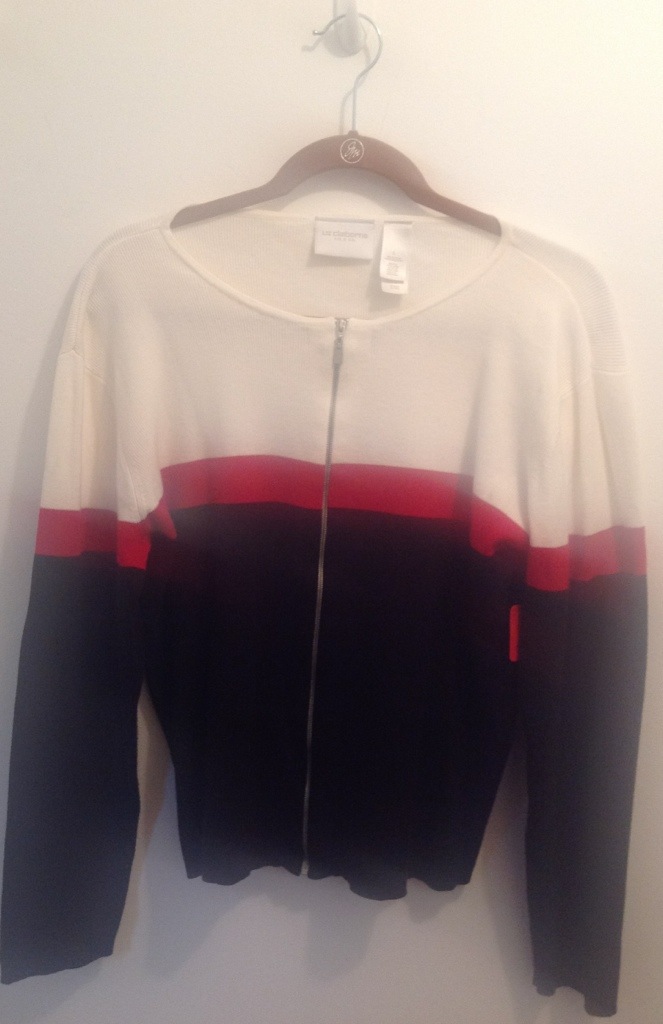
2 bucks at the thrift store
Liz Claiborne zippered cardigan. Lovely with black skinny jeans, heels and my signature fire engine red lipstick. Annnnnd it matches my black/red/beige multicolor gelish manicure!
Pretty in Pink

Ann Taylor floral jacket. Two bucks!
Romney won the debate
Only question: did Obama let him, intentionally?
Obama looked tired, weak, hesitant and sad. Romney looked strong, energetic and had a great smile.
Romney straight up lied and Obama didn’t call him on it.
Romney compared the president to his boys. Obama didn’t respond.
Romney used colloquial language and sounded relaxed. Obama was wonkish and boring.
Romney brought 40 people on stage after the debate. Obama looked lonely with his wife.
I can only imagine the Obama campaign threw the fight in some kind of Jedi mind trick strategy.
Should be interesting to see how this all plays out.
You know you’re an inspired/crazy academic when . . . .
You wake up at 6 AM on a Saturday morning, having slept a total of 3 hours, make a cup of coffee and gleefully get back to work on your lit review.
God, I’m so excited about my work right now
Haven’t experienced such an outpouring of productivity, creativity and motivation in my scholarship since I completed my dissertation over a year ago.
There’s this intuition and confluence of ideas, clarity and intellectual energy that’s just pouring forth. And the best part: it’s not driven by the kind of egoic, recognition-seeking, status-obsessed mania that is so characteristic of the tragic reality of human existence in general, not to speak of the tragic reality of academia. There’s just this clear, calm, confident flow going on that is unencumbered by the doubts, confusion, anxiety and stress that crushed me during graduate school.
Long days, long nights.
And it feels so good . . .
 Aware of Awareness